3-3-3 method
Life is busy.
The proposed 3-3-3 method tackles down tasks by following these rules:
3 hours of focused work
For the most important task of the day. Has priority over everything else.
ie: assignment, projects, etc
You'll get more done in 3 hours of focused work than 10 hours of distracted work
3 urgent tasks
For urgent and less time-consuming tasks. Do the things that you have been putting off.
ie: replying emails, organizing study plan, planning project
3 maintenance tasks
For nonwork, school tasks.
ie: laundry, meal prepping, chores
4/6/2024
Write Clean Code to Reduce Cognitive Load
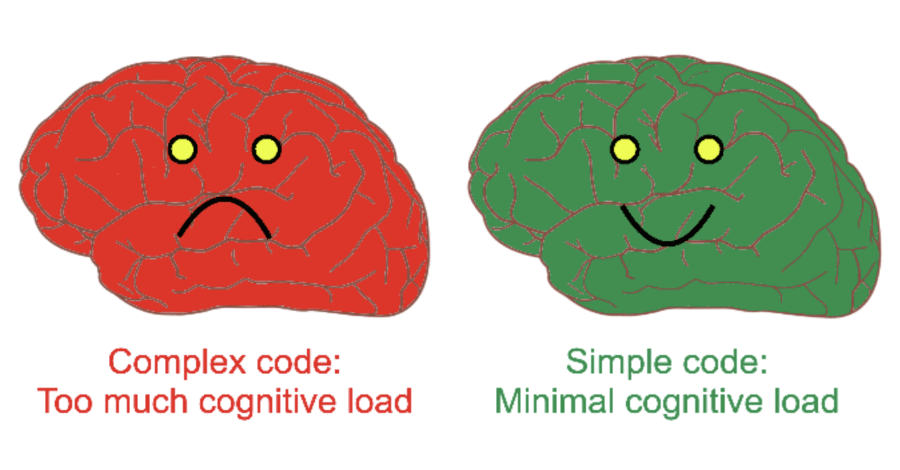
Cognitive Load (via the Google blog)
Today I stumbled upon a Google blog on writing clean code. It talks about why and how we should write Clean Code
Cognitive Load
Cognitive load is the amount of mental effort that is required to complete a task. In this case, our cognitive load grows with the complexity of the codebase. It's usually harder for other people to understand your code, because everyone writes code a little differently.
Be kind to your co-workers: reduce their cognitive load by writing clean code
Mantras
Some rules to always follow while writing code are:
1. Limit amount of code in function & files:
- single responsibility, keep functions small
- Make code self documenting with small functions (with good names)
2. Create abstractions to hide implementation details
- use abstractions, functions, interfaces hide complex details
- but don't over-engineer
- If you view a code, the intentions of it does not jump at you at first sight. Abstract
3. Simplify control flow:
- use helper functions to store conditional statements, loops to reduce nesting
- keep conditional blocks short
- if loops/ branches > 2 levels. refactor them
- move loops, conditional statements to functions
- google blog (simplify control flow)
4. Minimize mutable state:
- make types immutable
- avoid mutable class fields
5. Others:
4/3/2024
David Goggins: How to Build Immense Inner Strength

Adversity
Today I listened to Huberman's Podcast ft David Goggins.
Something that really caught my attention was when they talked about the Anterior Midcingulate Cortex (AMCC). It is directly responsible for people's Willpower & Will to Live. One of the key factors to the growth of your AMCC is to:
Do Hard Things
In fact, the only way to grow that part is to constantly challenge yourself by doing:
- Things that are hard and full of friction
- Things that you don't want to do
Just as easy as you can grow your AMCC, it'll shrink as easily as it grows. That's why you constantly need to feed it with challenges and adversity. It's like a campfire and the challenges are the logs that keeps it burning.
There are no hacks, It's you against you
Remarks
Most often times, I precisely know the exact steps for improvement. But the difficulty of it is holding me back. Goggins message to tackle this issue is just so simple and powerful: DO IT, and OUTWORK what you are capable of.
One of my favorite quotes from Goggins is definitely:
Stay Hard (its funny and motivational)
Sometimes I still avoid challenges because doing things that you suck at, just sucks...
But recently, I've been pushing myself in doing things that I SUCK at, I DONT want to do, I AVOIDED doing. Minor inconveniences, Major challenges, Unexpected problems, Just about anything. It's like making me not fear problems anymore and gives me the courage to brave any storm headfirst. I've also found myself to be even more optimistic in every outcome as I know there will always be a way.